Julius Evola
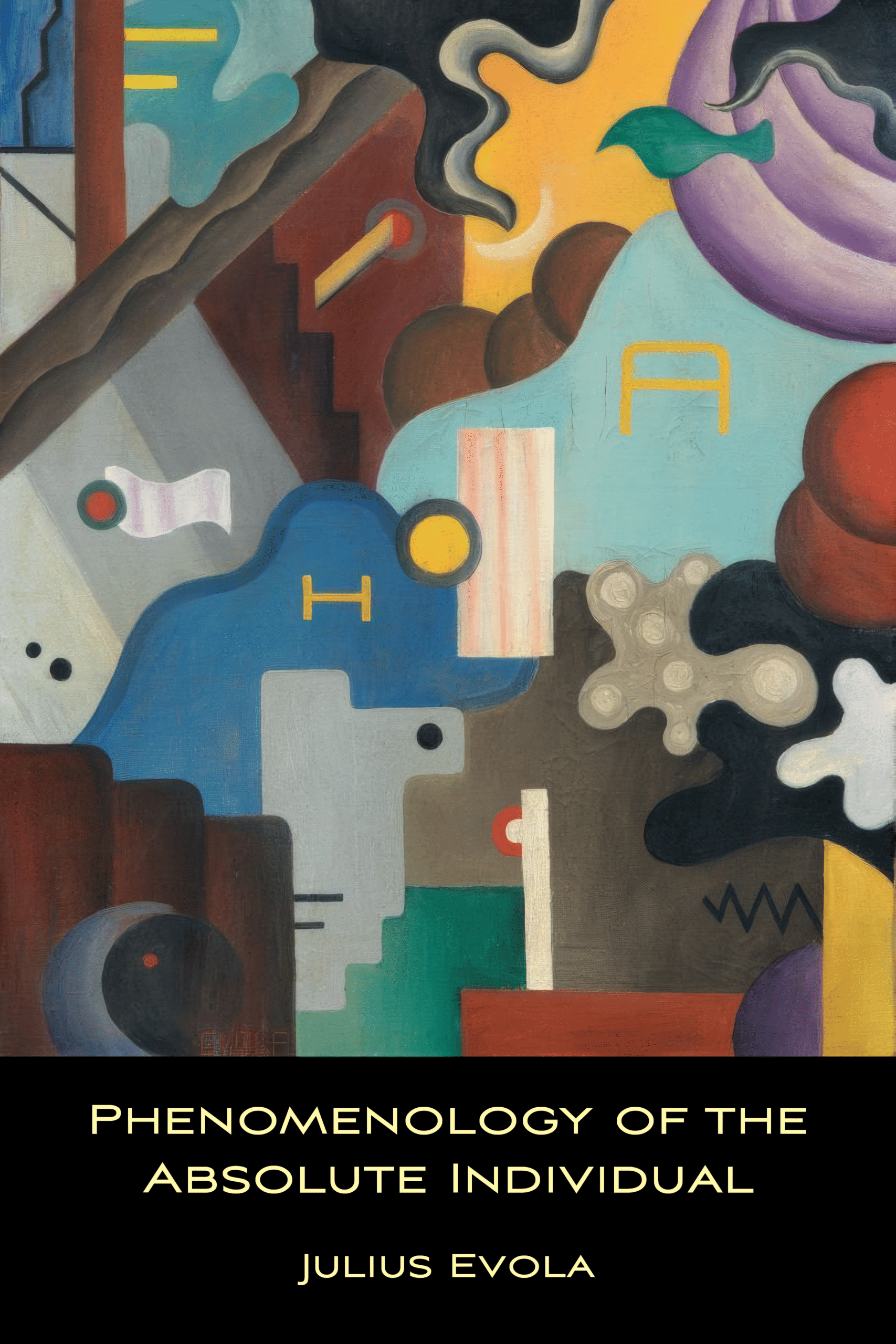
“Theory and Phenomenology of the Absolute Individual,” written by Julius Evola between 1917—when he was called up for military service—and 1924—when he was in Rome and had by then turned his attention to other subjects (art, Eastern doctrines, esotericism)—consisted of “300 protocol-format pages, four-fifths of which were handwritten.” The work was published by Bocca in two volumes, first the “Theory” (1927), then the “Phenomenology” (1930). After World War II, during his time at the military hospital in Bologna (1948–1951), Julius Evola synthesized and updated the “Theory,” which was published only in December 1973 and in a critical edition in this series in 1998; however, he did not perform the same revision for “Phenomenology,” which appeared in its original draft in early 1974, a few months before his death. The edition presented here is therefore still the 1930 edition, with typographical errors corrected.
From the preface: “This volume can be regarded as the second part of a total work, which has its first part in the already published Theory of the Absolute Individual and which, as a whole, constitutes the exposition of our doctrine in purely philosophical terms. It must remain firmly established that our ‘philosophy’ does not end in itself – all converging in a kind of postulation of an action – just as it does not begin in itself. In its essential elements, what we expound is not merely the product of the subjective speculation of a modern philosopher, but rather the intellectual transposition of certain traditional, primordial doctrines, not subject – in a certain sense – to becoming.”